
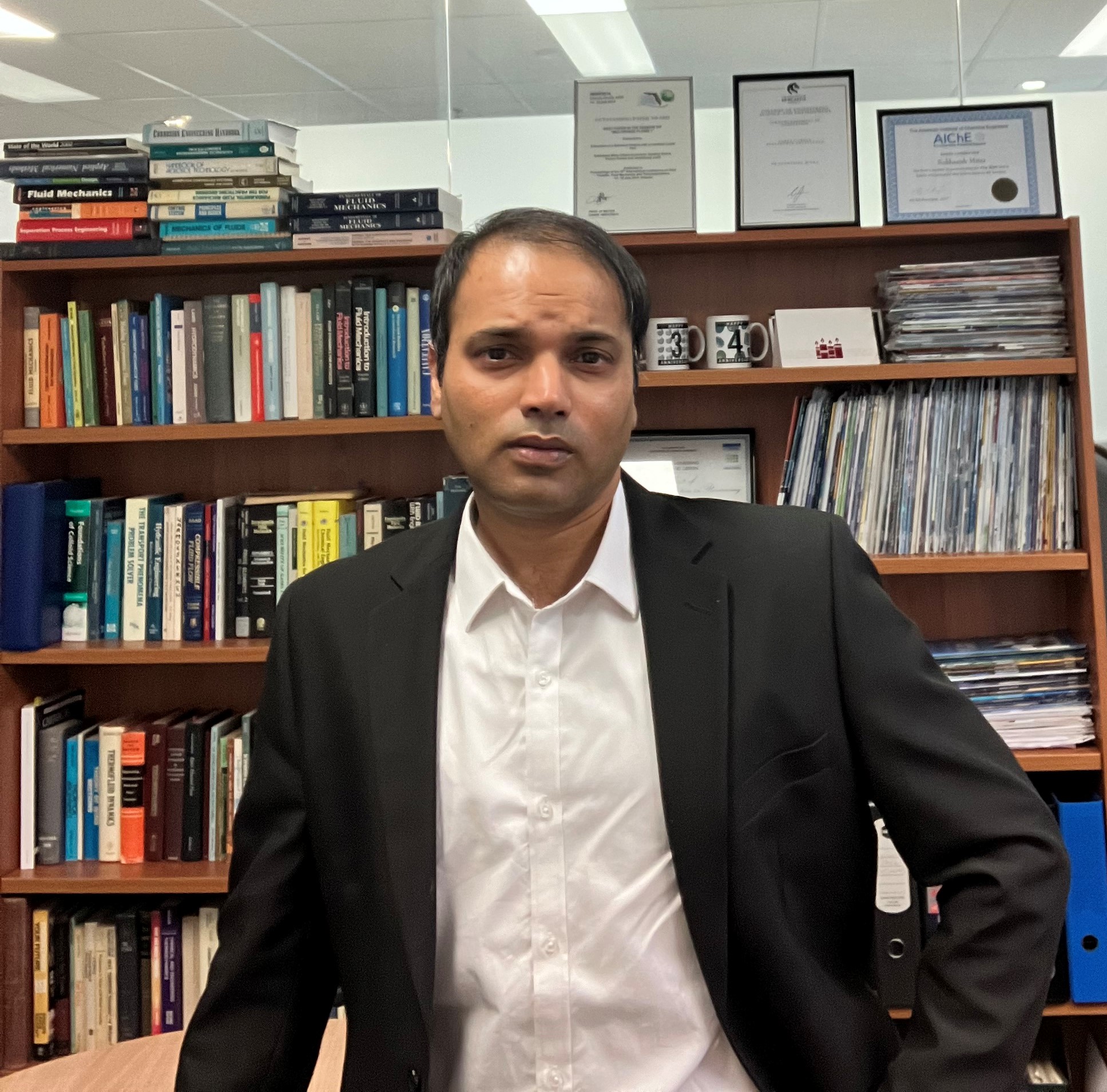
Rate My Professor Subhasish Mitra

Ratings & reviews
Creates a collaborative learning environment.
Makes complex topics easy to understand.
Always supportive and inspiring to all.
Encourages open-minded and thoughtful discussions.
Challenges students to grow and excel.
Creates a safe and inclusive space.
Taught by or worked with Subhasish?
Add your rating. It takes about 30 seconds.
About Subhasish
Dr. Subhasish Mitra serves as an Honorary Lecturer in the Discipline of Chemical Engineering within the School of Engineering at the University of Newcastle, Australia. He earned his Doctor of Philosophy from the University of Newcastle, Master of Technology from the Indian Institute of Technology Kanpur, Postgraduate Certificate in Nuclear Science and Engineering from Bhabha Atomic Research Centre in India, and Bachelor of Technology (Honours) from Vidyasagar University, West Bengal, India. Possessing over 15 years of experience spanning industry and academia, his professional trajectory includes roles as Senior Process Engineer at Petrofac Engineering India Ltd. from 2008 to 2009, where he handled process design for oil and gas projects; Process Technology Analyst at Ingenero Technologies from 2007 to 2008, focusing on process simulation for heavy alcohol separation; Manager (Process) at Reliance Industries Ltd. from 2005 to 2007, managing high-density polyethylene plant operations; and Scientific Officer at Bhabha Atomic Research Centre from 2002 to 2005, specializing in hydrometallurgy for uranium refining and mineral processing for nuclear fuel. Currently, as a research academic, he coordinates courses such as CHEE3690 Environmental Process Technology and CHEE2315 Fluid Mechanics for Chemical Engineers, and mentors final-year design and research projects.
Mitra's research centers on complex multi-phase flow systems integrated with heat and mass transfer, applied to mineral separation, iron and steelmaking, and water treatment processes. His investigations employ experimental methods including high-speed optical and thermal imaging, particle image velocimetry, and ultrasonic fields, alongside numerical approaches like computational fluid dynamics and discrete element method modeling for particle dynamics. Ongoing projects address hydrodynamics in Reflux Flotation Cells emphasizing bubble-particle interactions, softening and melting behavior of iron ore burdens in reducing environments, microplastics separation from wastewater, and droplet-surface interaction mechanisms involving phase change. He has supervised over ten PhD theses to completion, with principal and co-supervisory roles in topics like slag splashing dynamics and turbulence effects on bubble-particle interactions. Among his accolades are the 2024 Young Researcher Award at the Gas-Liquid and Gas-Liquid-Solid Conference (GLS16), 2017 Outstanding Contribution in Reviewing Award from Chemical Engineering Research and Design, and 2014 Outstanding Paper Award at the 10th International Conference on Heat Transfer, Fluid Mechanics and Thermodynamics (HEFAT). Key publications include the book 'Computational Fluid Dynamics Modeling of Trickle Bed Reactor Hydrodynamics, Reactor Internals, Catalyst Bed' (2011); 'A 2D Numerical Modeling Study of Slag Splashing in a Basic Oxygen Steelmaking Furnace' (2025); 'Numerical modelling of spreading dynamics of a single molten droplet impingement on a solid surface of different inclinations' (2024); 'Effect of Weber number and impact angle on solidification behaviour of a molten droplet on an inclined surface' (2026); and 'Measurement of gas dispersion parameters in a reflux flotation cell' (2025). His contributions advance optimized utilization of raw materials and energy in multiphase reactors, influencing mineral processing and metallurgical engineering fields.
Trending Engineering Research & Publication News

Ampere per Meter (A/m): Magnetic Field Unit | AcademicJobs
Photo by Ries Bosch on Unsplash

How Do Solar Panels Work? PV Cells Explained | AcademicJobs
Photo by American Public Power Association on Unsplash

Is Styrofoam Recyclable? Research on Polystyrene Recovery | AcademicJobs
Photo by Jonas Gerlach on Unsplash

Morgan Parker Scalpel Invention 1915 | Bard-Parker Design Legacy
Photo by Kedibone Isaac Makhumisane on Unsplash

Pumice Research Reveals Unique Qualities | AcademicJobs
Photo by Amin Hasani on Unsplash

How Long Does a Car Battery Last? Science & Tips | AcademicJobs
Photo by Daniel @ bestjumpstarterreview.com on Unsplash

Mother of Pearl: Research on Strength and Value | AcademicJobs
Photo by Nicole Almendrada on Unsplash